

Silverwell’s history is pieced together from mining and chapel records, newspaper archives, local memory, and the recollections of people who grew up here. Some of what follows draws on research published by two Cornish history projects, credited and linked at the bottom of this page.
How Silverwell got its name
An explanation of Silverwell’s name origin is found in a 1903 mining report by Charles Dysart Teague, once owner of Silverwell Mine. In it, he says the mine took its name from the village rather than the other way around, and recounts an old story that during a game of Cornish hurling the ball was lost in the valley and later found in a well – giving both the well and the village their names.
Village life
Silverwell was – and to a large extent still remains – a farming community with no real centre of its own – a scattering of cottages and farms straddling the parish boundary between St Agnes and Perranzabuloe. Greenacres Farm and Silverwell Dairy were among the working farms at the heart of village life. Before mains water arrived, households relied on hand-pumped wells like the one pictured further down this page, and mains electricity didn’t reach the village until the late 1950s. With no shop of its own, Silverwell depended on tradespeople doing the rounds by cart and van – a butcher, a baker, a grocer, and others – well into the twentieth century.
Methodist chapels
Methodism was central to village life for well over a century, and Silverwell had two chapels at different times. The Wesleyan chapel was first built in 1824, then rebuilt in 1900 after the original building became unsafe and had to be demolished – a project paid for and built by the local congregation. It served the village until closing in 1982, after which it was converted into a private home, which it remains today. A separate Primitive Methodist chapel stood nearby from around 1842 until it closed in 1883; that building no longer survives. Both chapels were on the located on a road linking Chiverton Cross to White Street. St Peter’s Mithian and White Street Chapel were located at either end.
Wheal Treasure (Silverwell Mine)
Silverwell also had its own small mine, Wheal Treasure, worked on and off without much success into the early twentieth century. Its distinctive chimney stack, built from an old iron boiler tube, was demolished during the Second World War so the metal could be reused for the war effort. A photograpgh of the mine from around 1930 is below and the foundations of the mine are still visible today.
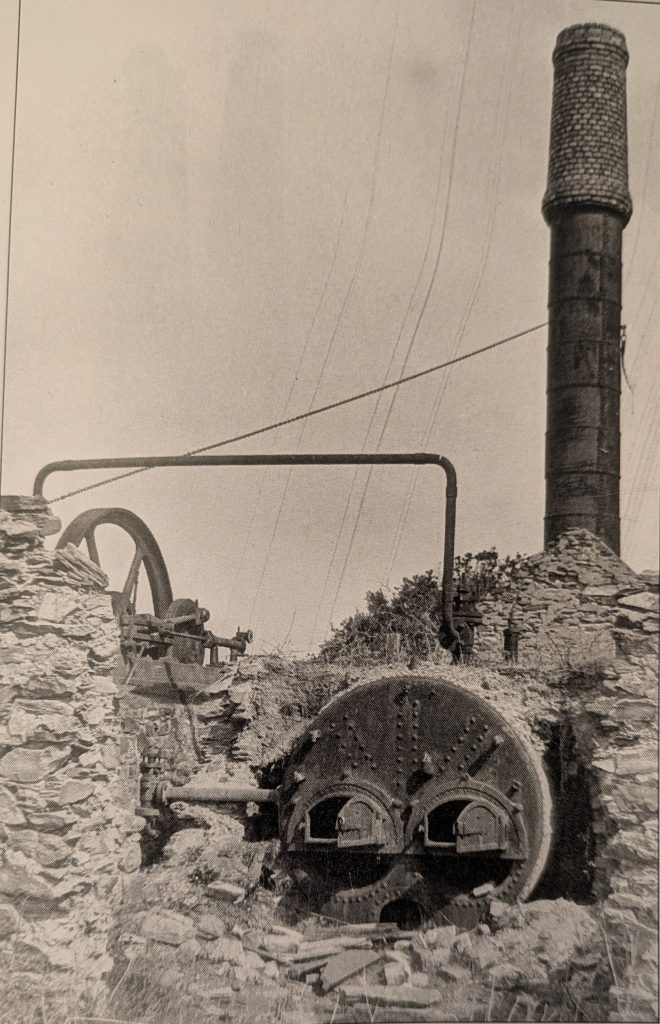
A strange sight even in a land of strange things! The remains of the pumping and winding machinery of a small lead prospect in the shallow valley a mile north of Mithian Church. It was known as Wheal Treasure or the Silverwell Lead Mine, but it was also cynically remarked that ‘It did not contain enough lead to make earrings for a black beetle!’ Apparently the old iron chimney (the fire tube from an old boiler) did not provide sufficient draught for this boiler and it was therefore heightened with the top-heavy brickwork seen in the picture. Even though two out of three supporting chains had rusted away, the old stack withstood all the gales and was only demolished during the scrap iron drive of the Second World War. The mine was last worked before the First World War.
Quotation from page 89 of Mining in Cornwall Volume Two ‘The County Explored’, bu J H Trounson and L J Bullen
The Village Green
Tucked just off the main road through Silverwell is Silverwell’s ‘Village Green’, featuring an old cast-iron parish pump, still standing on its granite base. It’s a reminder of how the village drew its water before mains supply arrived, and one of the few visible pieces of Silverwell’s history still in place today.


Sources and further reading
This page summarises information from the following sources, which cover Silverwell’s history in far more detail and are well worth reading in full:
- Silverwell – Memories of Pure Gold, by Tony Mansell, Cornish Story (2019)
- Mapping Methodism – Silverwell, compiled by Clive Benney and Tony Mansell for Kernow Goth (Federation of Old Cornwall Societies)
- BBC WW2 People’s War: an archive of World War Two memories – wartime recollections relevant to the area, contributed to the BBC’s People’s War project
- The Lunnener – A Story of a WW2 Evacuee from London to Silverwell
- Murder in Silverwell!
Know something about Silverwell’s history that should be on this page? Get in touch via the Contact page.